
How to respond when you’re put on the spot and not ready
What to say when your mind goes blank in a meeting


The question lands before you’re ready.
Maybe it’s the CEO, mid-presentation, asking why the roadmap looks the way it does. Maybe it’s a commercial director, arms folded, challenging a call you made three weeks ago. Maybe it’s someone in the room who’s decided today is the day they test you.
And your brain does one of two things. It goes completely blank. Or it floods, every thread, every caveat, every counterargument arriving at once, all of it competing for the exit.
You know you have the answer somewhere. But the pressure to find it right now, to respond without missing a beat, feels enormous. And anything less than instant feels like evidence. Evidence that you might not be quite executive material after all.
Here’s the assumption most people are carrying in that room: the best leaders always have a sharp, fast answer.
They don’t.
What they have is a system for staying composed when conditions aren’t perfect. That’s a completely different thing, and it’s learnable.
Some of us need a breath before we answer. Not because we don’t know, but because we’re actually thinking. Running the threads, checking the edges, making sure what we say is worth saying. That’s not a flaw in the way you’re wired. For a lot of people reading this, it’s probably your greatest asset. It just doesn’t always feel that way when thirty people are staring at you.
The leaders who look calmest under pressure aren’t faster. They’re better prepared for the moments when it gets messy.
Here’s a three-part toolkit that works.
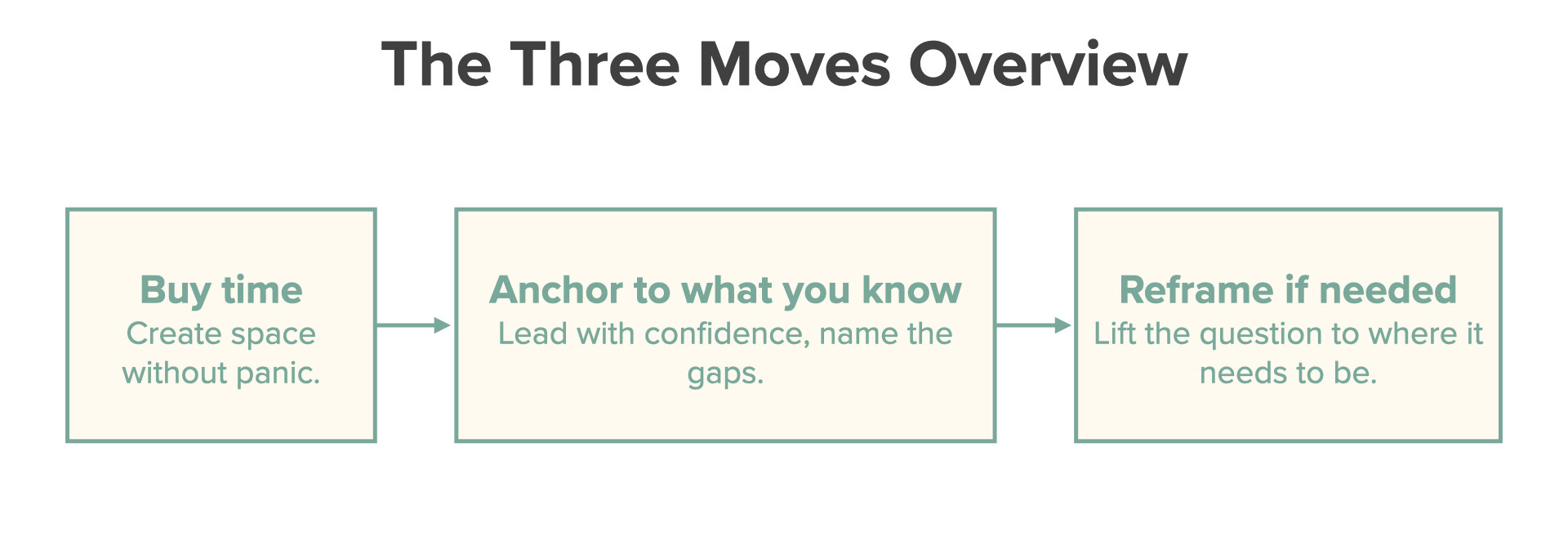
Move one: buy time without looking uncertain
There are phrases that create space without signalling panic. They don’t sound like stalling. They sound like someone who doesn’t rush to fill silence, which, in a room full of people who do, is quietly powerful.
Try: “That’s worth a considered answer, give me a second.” Or: “Good question. I want to make sure I’m answering the right thing. Are you asking about X, or Y?”
Both do the same job. They slow the pace, signal that you’re taking the question seriously, and give your brain the room it actually needs.
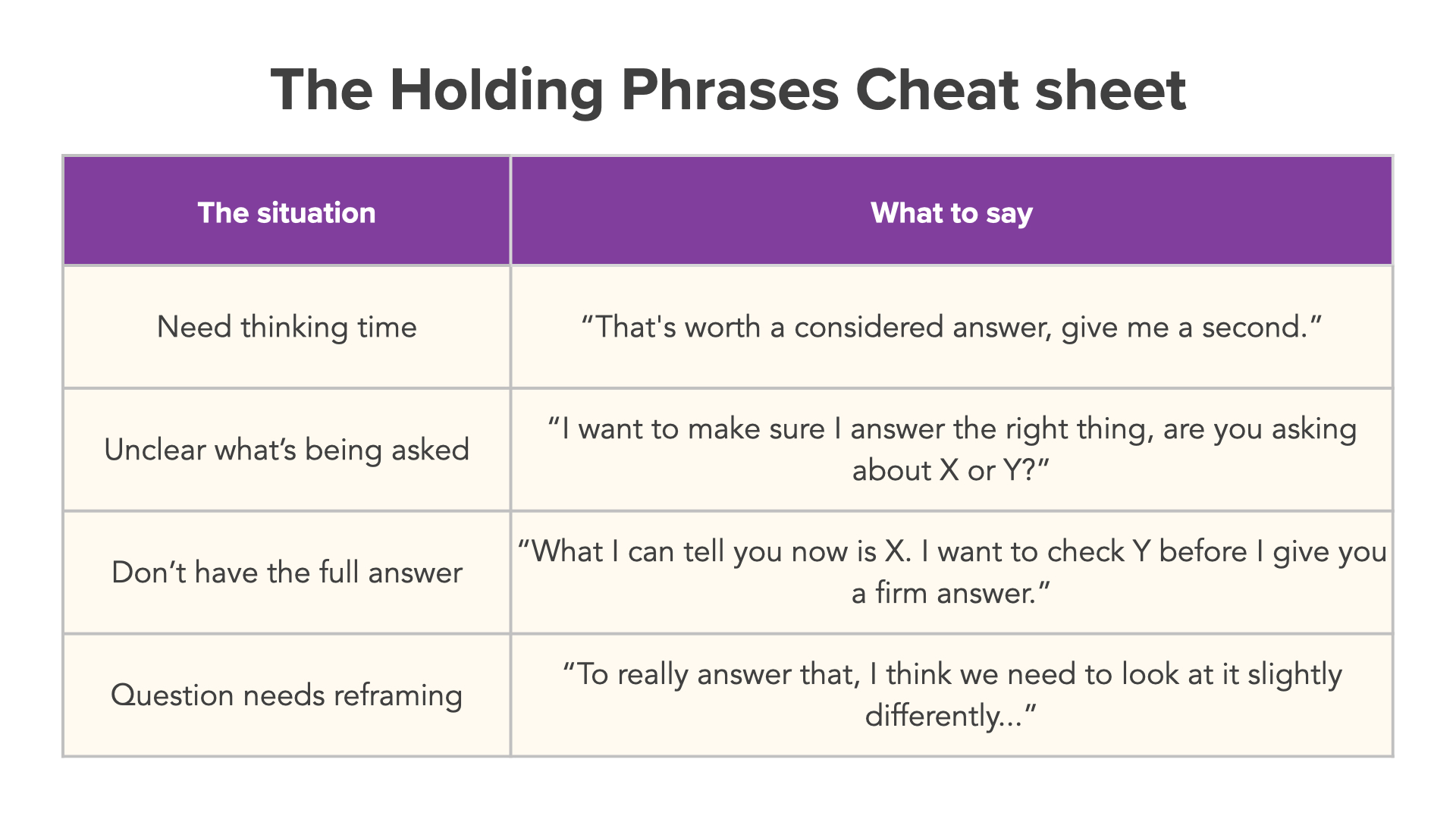
Move two: anchor to what you do know
You won’t always have the complete answer in the moment. That’s not a problem, unless you pretend otherwise.
Lead with what you’re confident about. Name what you’ll come back on.
“What I can tell you right now is X. I want to check the details on Y before I give you a firm answer on that part.”
That’s not a gap in your credibility. That is your credibility. It’s far stronger than bluffing your way through, and far stronger than going quiet and hoping no one notices.
Move three: reframe and redirect
Sometimes the question being asked isn’t actually the right question. And if that’s true, the most powerful thing you can do is say so.
“To really answer that, I think we need to look at the question slightly differently...”
Done well, this isn’t evasion. It’s strategic thinking made visible. You’re not dodging, you’re lifting the conversation to where it actually needs to be. That’s not a defensive move. That’s leadership.
What this looks like in practice
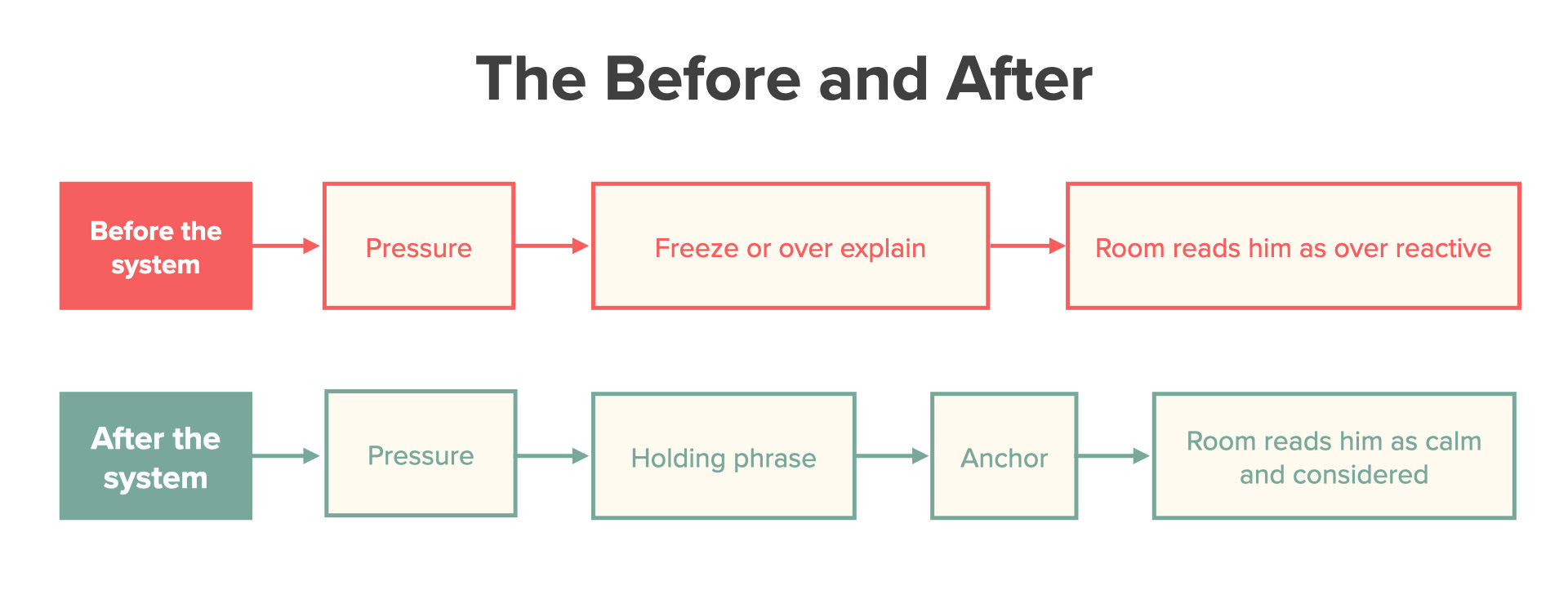
We worked with a Head of Product who would either freeze up or over-explain when put on the spot. Pressure sent him in one of two directions: shut down completely, or speed up and say too much. Neither served him.
Once he had two or three holding phrases that felt natural in his voice, not borrowed, not performative, just his, everything shifted. He started buying time with intention. He stopped bluffing and started anchoring. And the room started reading him differently. Not as someone scrambling to keep up, but as someone calm, considered, and worth listening to.
Same thinking. Completely different system.
Your one thing to do before the next meeting
Write down two or three holding phrases that actually sound like you. Then say them out loud, not in your head, out loud. Your brain needs to hear them in your own voice before it can reach for them under pressure.
When the moment comes, you won’t have to think. The words will already be there.
“Won’t people see through it? Won’t it look like I’m stalling?”
Here’s the honest answer: buying time with intention reads as composure. Blurting a half-formed answer because you felt the pressure to fill the silence reads as reactive. The pause isn’t the problem. The pause is the point. It tells the room you take the question seriously. That you don’t just say the first thing that comes to mind.
That’s not stalling. That’s judgment.
You don’t need to have every answer instantly. You need a system that keeps you in the game while you find them.
Buy time with intention. Anchor to what you know. Reframe if the question needs it.
Three moves. That’s it.
Find out where your communication and influence can be strengthened Take the Signal Drift assessment.